Clinical assessment & objective data
Symptoms, history, goals and clinical examination are considered alongside relevant biomechanics, movement, strength and muscle function measurements.
Clinical treatment & rehabilitation
Clinical assessment, treatment and rehabilitation for pain and injury. Whether your goal is returning to everyday activity, work, training or sport, your assessment guides an individual plan using the most appropriate combination of treatment, objective testing and progressive exercise rehabilitation.
The clinical approach
Zane combines clinical judgement and qualitative assessment with objective information from 3D posture and movement analysis, dynamometry, EMG and movement sensors. With a particular interest in biomechanics, he considers measurable information alongside your symptoms, history, goals and clinical examination.
Technology supports clinical decisions rather than replacing them, and not every patient requires every form of testing or treatment.
Symptoms, history, goals and clinical examination are considered alongside relevant biomechanics, movement, strength and muscle function measurements.
Manual treatment and advanced technology are selected for a clear clinical purpose. Not every person needs every technique.
Individual exercises develop movement, strength, capacity and confidence, with reassessment used to guide progression where appropriate.
An objective starting point
After discussing your symptoms, history and goals, 3D posture analysis can provide a visual baseline of posture, alignment and relevant differences between sides.
The visual information supports further assessment and helps inform an individual treatment and rehabilitation plan where appropriate.
Posture varies between people. Findings are interpreted alongside your symptoms and the wider clinical assessment; they do not establish the cause of pain or provide a diagnosis.
Explore muscle & movement testing ↓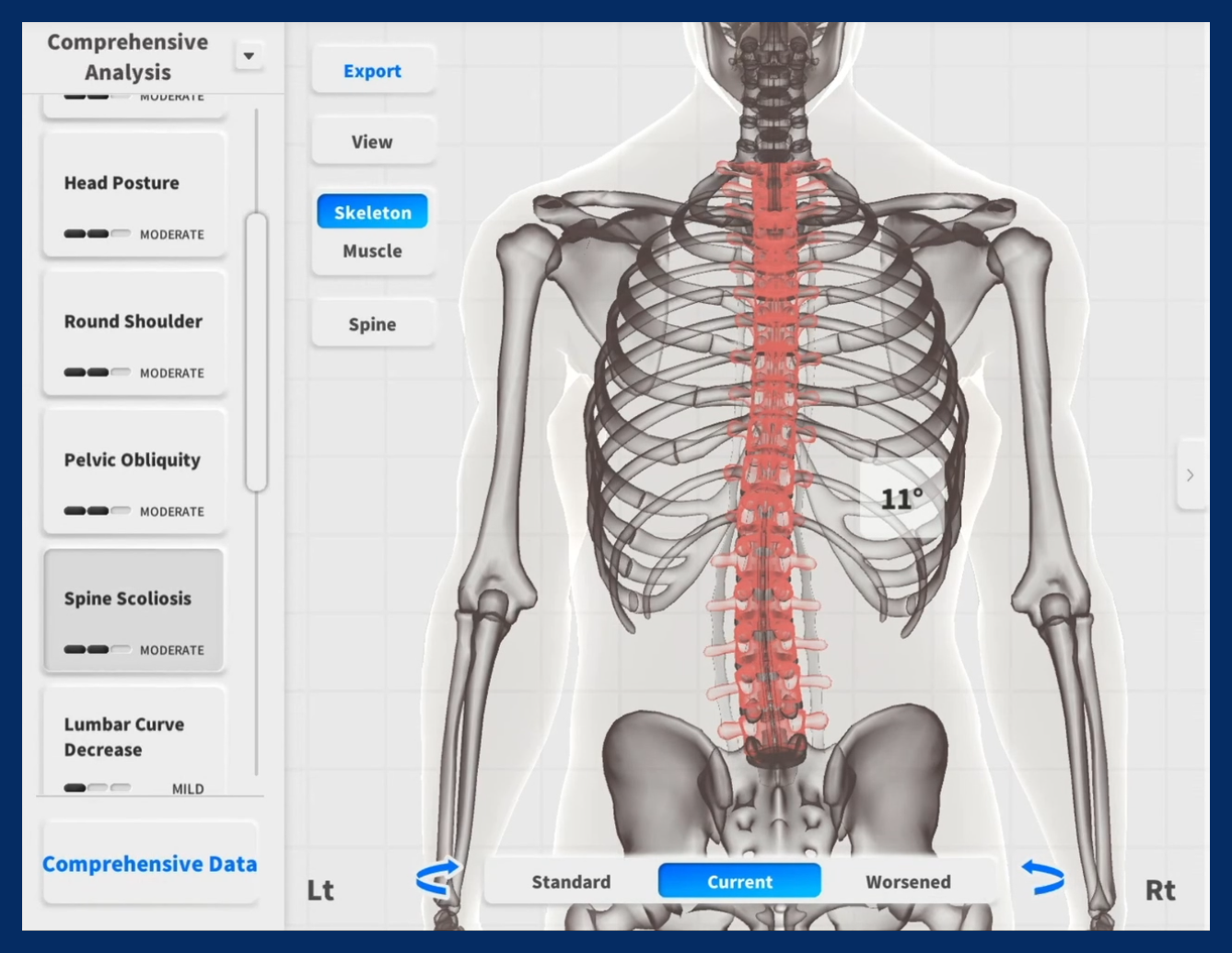
Objective muscle & movement testing
Posture analysis provides a visual baseline. Where relevant, dynamometry, EMG and movement sensors add measurements of force, activation and movement. Together with your symptoms and goals, these findings support rehabilitation planning, with reassessment used to monitor change.
Measures muscular force so strength can be quantified, compared between sides and reassessed over time.
Examines muscle activation and recruitment to support clinical decisions. It is not a neurological diagnostic test.
Provide measurable information about movement, control and relevant differences during selected tasks.
Results can help quantify asymmetry, monitor change and support decisions about progressing rehabilitation.
These measurements support professional assessment and rehabilitation planning; they do not provide a standalone medical diagnosis.
Advanced treatment technology
Shockwave and Class 4 laser are selected for a clinical reason and used as part of an individual treatment and rehabilitation plan.
BTL technology
Focused acoustic energy used as part of a wider plan for selected persistent tendon and soft tissue conditions.
Suitability is established during assessment. Shockwave is not appropriate for every condition or every patient.
High intensity photobiomodulation
Therapeutic light delivered at higher power to support pain management and tissue recovery alongside appropriate movement and loading.
The laser is selected according to the presentation and used as one part of an individual clinical plan.
A broad clinical toolkit
Assessment guides the approach. Depending on your needs, treatment can combine manual techniques, technology and progressive exercise.
Exercise rehabilitation
Passive treatment can be useful, but it is rarely the whole answer. When exercise is appropriate, you receive a programme designed around your present capacity and the movements that matter to you rather than a generic sheet of exercises.
The plan progresses as you do, with reassessment used to guide loading, movement and return to activity.
Clinical pricing
Pain, injury or movement problem?